Start with the interface
Grip is not a fixed property stored inside a shoe. It emerges when an outsole interacts with a surface under particular conditions. A clean rubber sole on dry pavement and the same sole on an oily kitchen floor are different systems. The direction of force, the loading and the state of the contact surface can all change the outcome.
This is why a confident “grippy” description needs a second question: grippy where? Everyday sneakers, trail shoes and workplace footwear may be designed around different problems. A lug pattern intended to engage loose soil should not be assumed to provide certified slip resistance on a contaminated industrial floor. Visual similarity is not evidence of equivalent performance.
Compound and pattern do different work
A rubber compound combines a base polymer with other ingredients that help determine its processing and final behavior. Fillers, curing systems and additives influence properties such as wear resistance and deformation. “Rubber” is therefore a broad description, not a single recipe. Terms such as carbon rubber and blown rubber are useful starting points, but they still leave many formulation details unspecified.
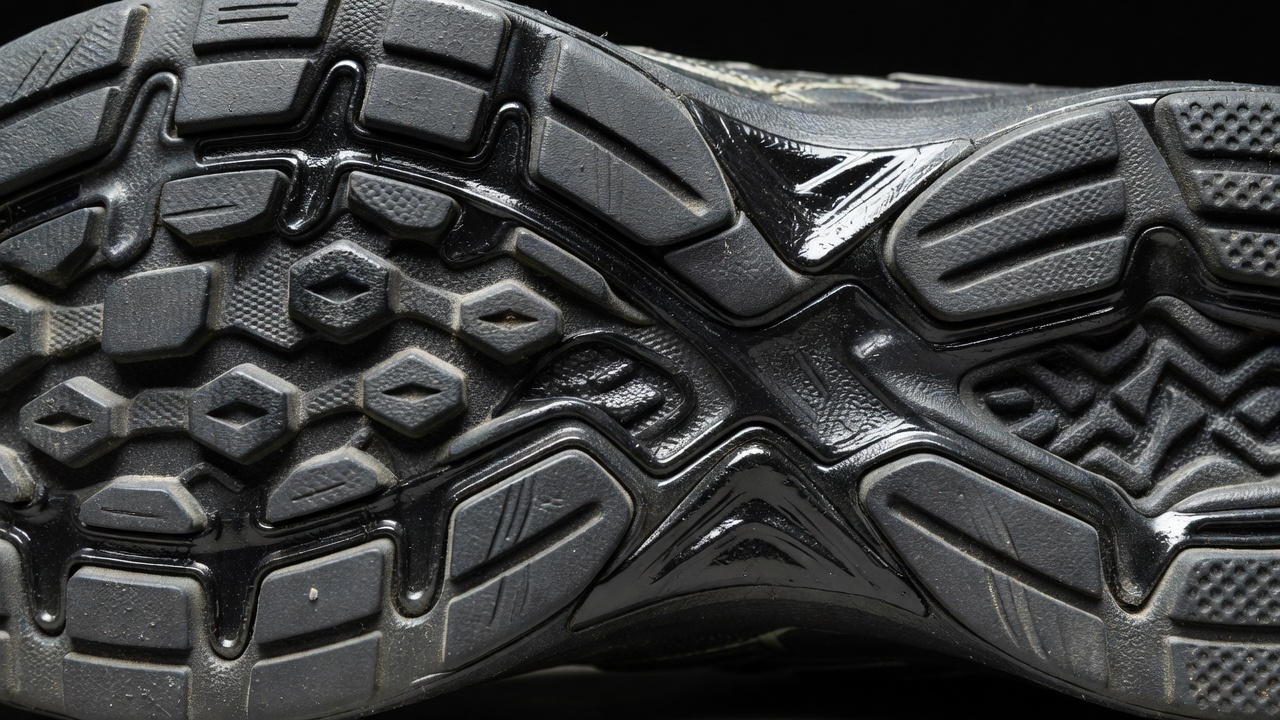
Tread changes where and how the outsole contacts a surface. Grooves can provide space for material to move, while protruding lugs can engage deformable ground. On hard ground, the size and shape of the contacting blocks matter. Tall, flexible lugs can feel less settled than a flatter outsole, especially when turning. That does not make them poor designs; it may mean they are being used outside their intended setting.
Vibram Megagrip is a named rubber compound platform promoted for wet and dry grip. Continental also supplies rubber technologies used in footwear. These are real manufacturer systems, but a supplier name does not establish that every sole using that name has identical traction. The outsole pattern, rubber coverage, shoe geometry and test surface still need to be considered.
| You can observe | It may tell you | It cannot establish |
|---|---|---|
| Deep, spaced lugs | An intention to engage loose or uneven ground | Safe grip on wet polished floors |
| Broad rubber coverage | Where abrasion-resistant contact material is placed | A universal durability ranking |
| Polished tread areas | Localized wear and repeated contact | A medical diagnosis of your gait |
| Exposed foam | A construction choice that may reduce rubber use and mass | How quickly that particular shoe will wear out |
Read tests as methods, not magic words
ISO 13287 sets out a method for testing slip resistance of personal protective footwear. ASTM F2913 describes a whole-shoe method for measuring coefficient of friction. A reference to either standard is more informative than a vague adjective, but it still requires context: which edition, what surface, which contaminant and what result? A test method is not automatically a pass mark or a promise of safety in every environment.
If your workplace requires protective footwear, use the specified certification and employer guidance rather than a lifestyle sneaker's marketing copy. Different hazards demand different protection. Slip resistance does not by itself establish puncture protection, electrical properties or toe protection, and none of those should be inferred from an outsole photograph.
A test result travels with its conditions. Remove the conditions and the number loses much of its meaning.
Wear changes the contact surface
Look for tread that has flattened, rubber worn through to another layer, cuts, trapped debris and edges that have begun to separate. Check both shoes; your daily routes and movements do not necessarily load them symmetrically. Uneven wear is a useful observation, but reading it as a diagnosis of pronation or injury risk goes beyond what that evidence can support.
Dirt can also obscure the outsole you are trying to inspect. Remove loose debris and clean according to the shoe's instructions. Avoid solvents or improvised chemical treatments intended to make rubber sticky. They may damage components or create a temporary surface effect that is difficult to predict. There is no household shortcut that turns an unsuitable shoe into certified protective footwear.
Match the shoe to the ordinary route
Think about the surfaces you encounter most often: smooth indoor floors, rough pavement, park paths or loose trails. Also consider the transitions between them. Water carried from outside can change an indoor contact, and mud packed between lugs can alter how a sole engages the ground. Choosing for one ideal surface may miss the moments that matter most in everyday use.
Do not test traction by deliberately sliding on a hazardous floor. Use cautious normal movement in a safe setting, keep walking surfaces clean where possible and follow relevant safety guidance. When grip has noticeably deteriorated, cleaning or replacing the shoe may be more sensible than trying to interpret a branded compound as a guarantee.
Sources and testing boundaries
- Vibram — official information on Megagrip and outsole applications.
- Continental — company information on rubber technologies and footwear partnerships.
- ISO 13287 catalogue search — personal protective equipment, footwear slip-resistance test method; check edition and scope.
- ASTM International — search F2913 for the whole-shoe coefficient-of-friction test method and current edition.
We have not tested the pictured outsole. No claim of certification, a measured friction value or superiority over another product is implied.