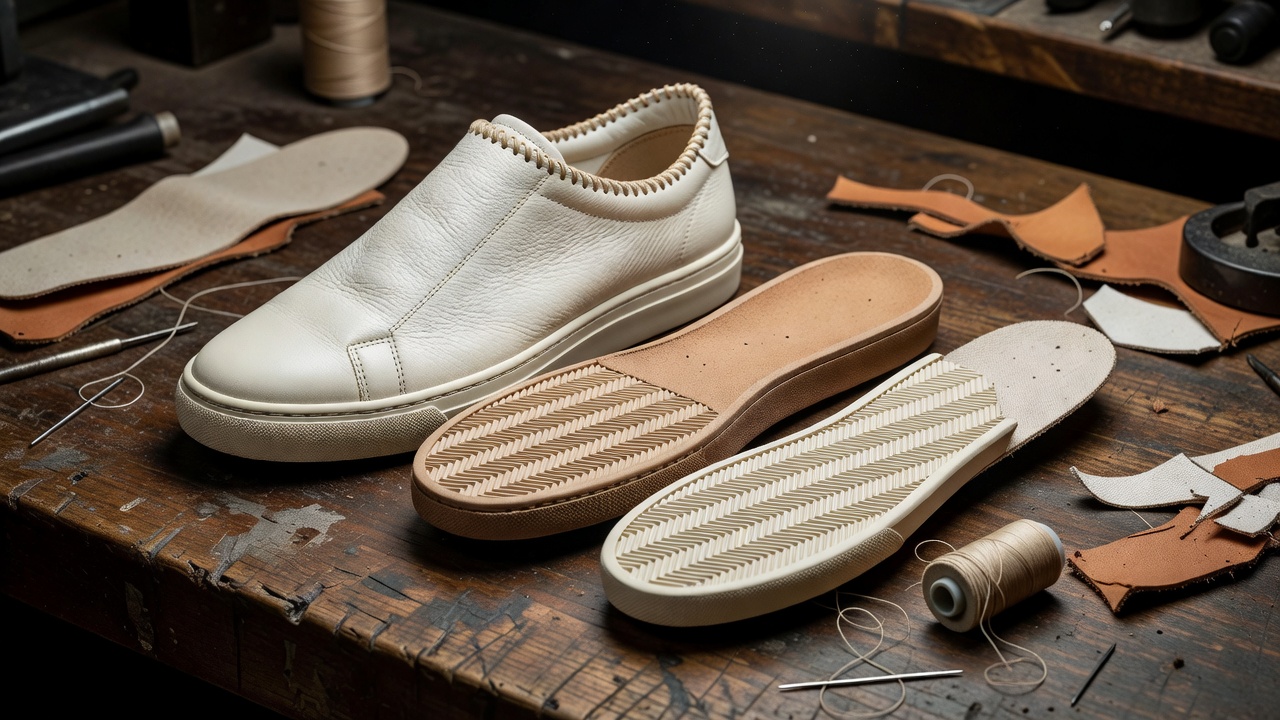
The last gives the shoe its working shape
A footwear last is a three-dimensional form used to shape the shoe during construction. Its geometry helps establish internal volume, toe shape and heel proportions, but the finished fit also depends on material thickness, pattern design and assembly. Two shoes sharing a nominal size can feel different because sizing labels do not describe every dimension of the last or the finished upper.
During lasting, the upper is positioned and tensioned around the form using a method appropriate to the design. This stage helps explain why an attractive material list cannot predict fit on its own. The same broad categories of fabric and foam can be assembled into shoes with different volumes and different pressure points.
Strobel construction closes the upper underneath
In a common Strobel construction, the lower edge of the upper is stitched to a flexible bottom component, creating a sock-like assembly before it is joined to the sole unit. The exact materials and production sequence vary. A removable sockliner may conceal this construction from the wearer, and not every shoe uses a removable liner or the same underlying seam.
Strobel stitching should not be confused with stitching the rubber outsole directly to the upper. It performs a different joining task. Other footwear may use board-lasting, combinations of methods or specialized molded constructions. Goodyear welted footwear offers another joining approach, often associated with certain leather shoes and boots, but it is not the default structure of a modern athletic sneaker.
The adhesive bond is a prepared interface
Many sneakers use cemented construction to attach the upper assembly and sole components. A reliable bond depends on more than choosing a strong adhesive. Surfaces may need cleaning, roughening or other preparation; compatible primers, controlled application, activation and pressure may all be part of the process. The correct sequence depends on the materials and adhesive system.
Adhesive manufacturers such as Henkel and H.B. Fuller publish footwear bonding information because different substrates create different problems. Rubber, foamed polymers and coated textiles do not necessarily accept the same treatment. A seam that appears simple from the outside may conceal several tightly controlled manufacturing steps. Adding household glue to a failed joint does not recreate those conditions.
Illustrated cutaway / Not to scale
A visible gap does not tell the entire failure story
When a sole begins to separate, the failure can occur at an interface or within one of the materials itself. Foam tearing beside a bond is different from two intact surfaces pulling apart. Age, moisture, heat, mechanical stress and manufacturing defects can contribute in different ways. A photograph may document the damage without establishing its cause.
ISO 17708 addresses upper-sole adhesion testing for whole shoes. It offers a structured way to examine a joining property rather than relying on a casual pull. It does not mean that a consumer should perform a destructive test at home. SATRA also provides footwear testing and technical resources covering construction and performance. A claim that a shoe was “tested” should still identify the relevant method and result.
A strong join is useful during wear. The same join can make separation difficult when the shoe reaches the end of its life.
Repair starts with a realistic assessment
A footwear repairer may be able to address a localized separation or replace certain components, but many molded athletic shoes were not designed for routine resoling. Access, material condition and the availability of a compatible replacement sole matter. Repair cannot reliably restore a foam that is crumbling throughout or a torn substrate that no longer provides a sound bonding surface.
If a join begins to open, stop using the shoe for demanding activity and seek advice from the retailer, manufacturer or a qualified repairer. Keep photographs and purchase information where available. Avoid heating, aggressively sanding or applying solvent before a warranty assessment: those actions can change the evidence and may create additional damage or exposure risks.
Design for separation is a different task
Recycled content and recyclability should be read separately. A shoe can contain recycled yarn yet remain difficult to separate into useful material streams. Mixed polymers, small reinforcement pieces, coatings and adhesives complicate processing. A take-back scheme also needs scrutiny: collection, reuse, material recovery and energy recovery are not interchangeable outcomes.
For a practical buying question, ask whether the exact product has an available repair service or a documented collection route where you live. Do not assume that a global sustainability statement guarantees a local option. Keeping a suitable pair in service through sensible cleaning and timely repair can be useful, but durability and end-of-life claims still need evidence rather than a reassuring label.
Sources and construction boundaries
- SATRA — footwear technical resources, construction information and testing services.
- Strobel — specialist sewing-machine information and Strobel seam applications.
- Henkel Adhesive Technologies — footwear adhesive systems and substrate-dependent bonding.
- H.B. Fuller — footwear bonding applications and industrial adhesive guidance.
- ISO 17708 catalogue search — whole-shoe upper-sole adhesion testing; consult the relevant edition.
This is an explanation of construction, not a repair procedure or a finding about a particular manufacturer's quality.