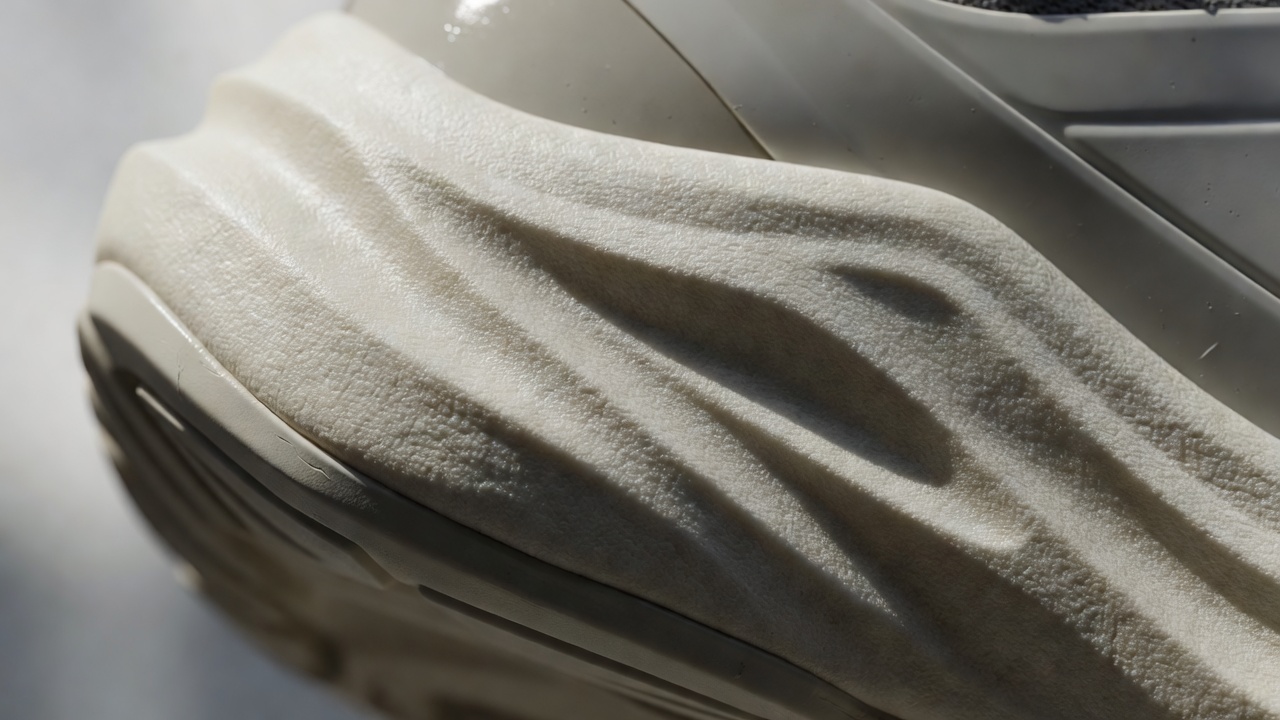
A solid-looking layer with space inside
Footwear foam contains a polymer structure and gas-filled cells. Under load, that structure deforms and then recovers to some degree. The result depends on the polymer, the way the foam was processed and the load being applied. Two midsoles carrying the same broad material label can behave quite differently because their formulations and cellular structures are not identical.
Density describes mass relative to volume. It is useful information, but it is not interchangeable with firmness. Nor does visible thickness tell you how far a midsole will compress beneath a particular wearer. A tall, relatively firm platform may move less than a thinner, softer one under the same local force. Shape and the surrounding components change the experience again.
Three families, many possible recipes
EVA, short for ethylene-vinyl acetate, is a widely used cushioning polymer. It can be formulated and processed into light, flexible foams with a broad range of properties. Calling a shoe “EVA-based” does not reveal every ingredient, how it was expanded, or whether the finished midsole combines several materials.
TPU means thermoplastic polyurethane. Expanded TPU can be made into foamed particles that are joined into a larger component. BASF describes its Infinergy platform as expanded TPU; adidas Boost is a familiar commercial application of this general bead-foam approach. The visible bead pattern may be informative, but appearance alone cannot confirm a particular supplier, formulation or performance level.
PEBA, or polyether block amide, is another polymer family used in performance cushioning. Arkema supplies Pebax elastomers, and Saucony describes PWRRUN PB as a PEBA-based cushioning technology. A polymer family can support low-density, resilient foam, but it is not a universal guarantee that a finished shoe will feel softer, last longer or suit your gait.
Illustrated cutaway / Not to scale
Softness and resilience are different questions
Softness is about resistance to deformation under specified conditions. Resilience concerns how much energy a material returns as it recovers. A soft material can dissipate substantial energy; a firmer material can be comparatively resilient. Neither property should be reduced to a single thumb press, particularly when the sidewall is shaped differently from the foam directly beneath the foot.
Laboratory energy-return percentages need context. The loading rate, force, temperature, specimen dimensions and number of cycles all matter. A percentage measured on a sample of foam is not automatically the percentage returned by a complete shoe. It is also not a direct percentage improvement in a person's running economy. Those are different questions requiring different measurements.
Ask what was tested: a polymer, a foam sample, a complete shoe or a person wearing it.
Geometry makes the material wearable
A broad sole, raised sidewalls and a carefully shaped transition can make a compliant foam feel more controlled. A plate or other stiffening element can change bending behavior and how pressure is distributed, but it does not act independently of the foam around it. There is no simple rule that a plate makes a shoe more stable, or that softer cushioning prevents injury.
Nike Air also illustrates why cushioning is not synonymous with foam: the system uses pressurized gas within a flexible unit. Nike React is a branded foam platform, while ASICS GEL is a different named cushioning technology. These names describe distinct approaches, not entries on one standardized comfort scale. Their placement and surrounding construction remain important.
Notice change without inventing a lifespan
Polymer response can change with temperature, and repeated use can alter cushioning behavior. Some materials are more sensitive than others; the size of the effect depends on formulation and conditions. Avoid leaving shoes beside a heater or in a very hot vehicle, and follow the model's care instructions rather than trying to restore foam with heat.
For everyday inspection, compare the shoes on a flat surface and look for new leaning, deep localized collapse, cracks or separated layers. Wrinkles alone are not proof that cushioning has failed. Conversely, a neat-looking sidewall does not prove that the feel is unchanged. If comfort or steadiness has changed noticeably, treat that as a reason to reassess the shoe, not as a laboratory diagnosis.
Sources and material boundaries
- BASF Infinergy — expanded TPU construction and supplier-described properties.
- adidas Boost — the manufacturer's explanation of its cushioning platform.
- Arkema Pebax — PEBA elastomer applications and material background.
- Saucony — consult the specific product description for PWRRUN PB composition.
- Nike Air and Nike company reporting — brand explanations of Air and React.
- ASICS — official GEL technology and model descriptions.
These sources establish named technologies and intended construction. No independent head-to-head test or universal injury-prevention benefit is claimed here.